
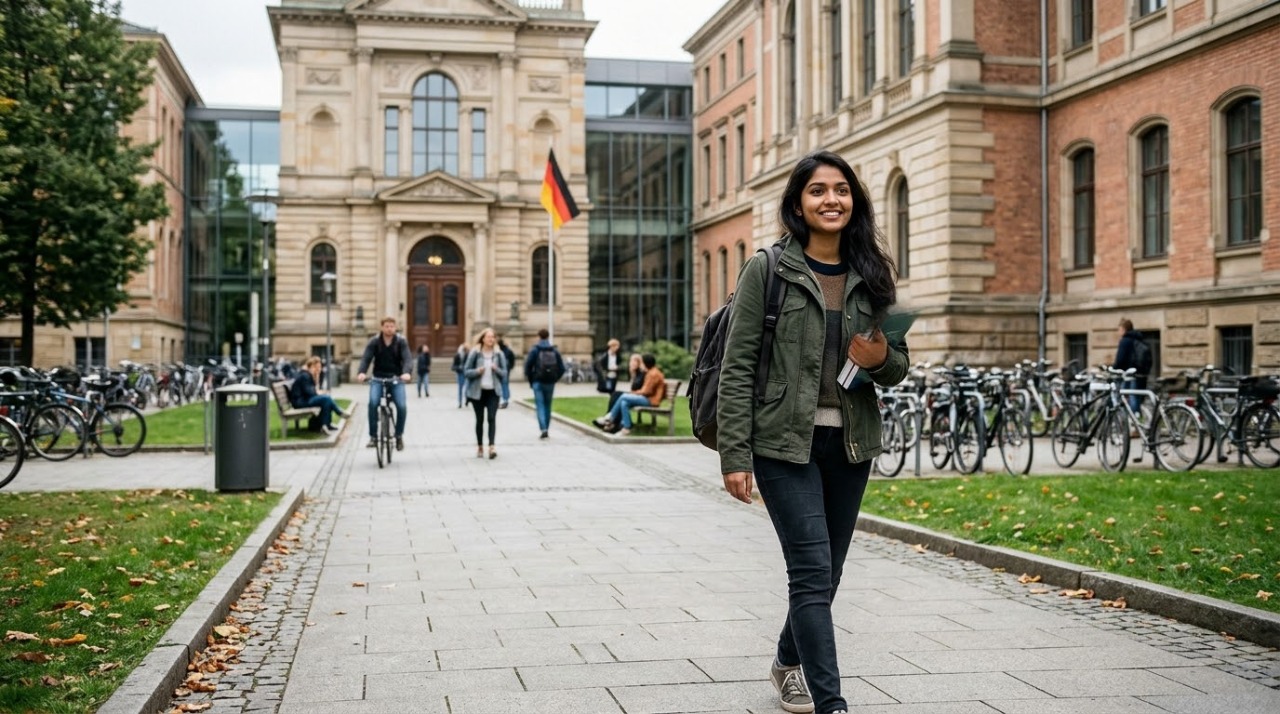
In Germany, the public universities receive government funding. Therefore, the majority of public universities offer bachelor's programs and many master’s programs to international students, including Indian applicants, without charging regular tuition fees. Students still have to pay semester contributions and living expenses. Further, some states and universities also charge tuition fees to non-EU students.
Students have to pay tuition fees when studying at:
Some of the best public universities for Indian students are listed below.
As these universities offer different programs, admission requirements and language options, students should check whether their chosen course is available in English or requires German language proficiency. Also, not every program at these universities is tuition-free.Universities like TUM have tuition fees for all non-EU students.
Students should check the requirements of the program, admission and also the language options before enrolling for a program.
Note: Students looking for English-taught programs can use the DAAD International Programs database to search for courses based on subject, degree level and language of instruction.
The general admission requirements are as follows
A direct admission to a bachelor’s degree is not guaranteed by completing Class 12. Students must check their academic qualifications according to German university entrance requirements.
The Academic Evaluation Centre (APS) certificate is required for many Indian students who are applying to study in Germany. APS India verifies the authenticity of Indian academic qualifications and the supporting educational documents. Indian students generally need an APS certificate as part of their German student visa documentation unless they are subject to applicable exemptions.
From summer semester 2027, Indian master’s applicants with an engineering, commerce, finance, economics, business or management degree must take the new Digital Master Test (dMAT) as part of APS. People who registered for APS before 29 June 2026 are exempt.
Read to know more: New Brunswick PNP 2026: Streams, Eligibility and How to Apply - ImmiLaw Global
In German universities, there are programs that are taught in English and German.
For programs that are taught in English, universities may accept IELTS, TOEFL or other recognized English proficiency certificates. The required score depends on the program. Whereas students may need qualifications such as TestDaF, DSH or recognized Goethe certificates for German-taught programs.
International students from India are generally permitted to work up to 140 full days or 280 half-days per year while studying in Germany.
Indian students applying for a German student visa are to provide proof of sufficient funds that will cover their living expenses. The required financial proof for 2026 is €11,904 per year (€992 per month). It must be deposited in a blocked account (Sperrkonto). Recognized scholarships or other approved financial guarantees may also be accepted. Furthermore, students must also arrange health insurance and submit their university admission and other required visa documents.
Even though there are tuition-free universities in Germany, Indian students must meet their expenses for accommodation, food, transportation and also their health insurance.
According to DAAD, students should generally budget around €900–€1,200 per month, depending on the city and lifestyle.
Students must also pay a semester contribution of approximately €70–€430, depending on the university. Actual expenses vary by location and lifestyle.
Students can apply for scholarships to meet their living expenses and educational costs in Germany. Some of the scholarship options for students are
Indian students have an opportunity to pursue internationally recognized higher education without incurring a huge cost by studying at tuition-free universities in Germany. The excellent academic environment, wide range of English-taught programs and opportunities for international students make Germany an ideal study destination.
Free education in Germany for Indian students can be possible with careful consideration of several things such as selecting the right university and program, understanding the criteria for admission, financial requirements, student visa process etc.
ImmiLaw Global, immigration lawyers and consultants can help you to choose the most suitable university and program and also guide you with the application processes to turn your dream of studying in Germany into a reality. Through proper preparation you can achieve international qualification through an affordable route.
German universities generally offer two main admission intakes, which are the Winter Semester (starting around September or October) and the Summer Semester (starting around March or April). The Winter Semester offers a wider range of programs.
Yes. Indian students who successfully graduate from a recognised German university can work towards obtaining permanent residence in Germany. After completing their studies, they can apply for an 18-month residence permit to find qualified employment. Once they secure skilled employment, they can apply for a permanent settlement permit after at least two years, provided they meet the required conditions, including 24 months of pension contributions, B1-level German language proficiency and other eligibility requirements.
Several German public universities offer English-taught programmes, including RWTH Aachen University, the University of Bonn, TU Dresden, LMU Munich, Goethe University Frankfurt and Humboldt University of Berlin. Most of these universities offer tuition-free education for many programmes, although semester contributions and certain programme-specific fees may apply. The availability of English-taught programmes depends on the university, degree level and subject.
Yes. International students can generally work up to 140 full days or 280 half-days annually, subject to applicable regulations.
For 2026, students generally need to show €11,904 for one year as proof of financial resources for a student visa. Additional funds may be needed for tuition fees, semester contributions and also travel expenses.
APS certification is generally required for Indian academic qualifications when applying for a German student visa, subject to certain exemptions. From summer semester 2027, Indian master’s applicants with an engineering, commerce, finance, economics, business or management degree must take the new Digital Master Test (dMAT) as part of APS. People who registered for APS before 29 June 2026 are exempt.
Yes, some universities accept alternative proof of English proficiency or previous English-medium education. However, acceptance depends on the university and program.
Most public universities do not charge tuition fees for regular bachelor's and many master's programs. However, semester contributions and living expenses still apply. Some states and universities also charge tuition fees to non-EU students.













6afea508c57d9.jpg)



65be04cbad701.webp)


















 CANADA
 +1 (647) 767-0672
 INDIA